Friday, December 12, 2014
Deadliest December: Polar Bear
When you hear "polar bear" a fluffy white bear might pop into your brain. These massive bears look cute and cuddly, but they are actually extreme killers. Polar bears, or Ursus maritimus live mainly in the Arctic Circle. They make dens in the snowy masses of land. Polar bears can swim exceptionally well because of their massive paws, although they prefer land. Seals are their main food source; they use a method of hunting called still-hunting, where they stand near breathing holes in the ice and wait. When a seal comes up to breathe, they kill it. Polar bears are classified as "threatened" in the conservation status. The main reason is because of global warming, and the melting of the polar ice caps. While these animals cause at least ten deaths per year, they are still endangered, and we should help to keep these animals alive.


Sunday, December 7, 2014
Northern Goshawk
The northern goshawk, or Accipiter gentilis, is a ferocious diurnal raptor endemic to central and western north america. These terrifying birds of prey have blood-red eyes, dark grey feathers, a black beak, and long black talons, giving them a mysterious dark appearance. This goshawk is extremely territorial, and will attack any threat to their nest, even humans. They are swift hunters and can catch large prey, such as hares, ducks, and other waterfowl, with one blow from their sharp claws.
Gila Monster
The Gila monster, or Heloderma suspectum, is America's largest and only poisonous lizard species. It certainly lives up to the term monster. Their bite is extremely painful, as they latch on to their victim to let neurotoxins enter the wound. They are found in the deserts of the southwestern states, and part of Mexico. Gilas spend much of their time in their burrows, only coming out to eat. Due to ever-constant human encroachment, the Gila monster is viewed as threatened.
Coywolves
A coywolf is a hybrid between a wolf (Canis lupus) and a coyote (Canis latrans). Recently, due to small pure wolf populations, the coywolf has become America's newest top predator. The coywolf is much larger than a coyote, and hunts in packs. However, they have adopted a special trait from coyotes; they have a much lesser fear of humans than wolves. Almost all coyotes, unlike other hybrids, bred in the wild. Leading it to be one of the most successful non-man-made hybrids. Although many view coywolves as a nuisance, could they be nature's way of filling the gray wolve's niche as apex predator?
Thursday, December 4, 2014
Red Lipped Batfish
These strange looking fish have long and sharp nose and they also look like they put a lot of lipstick on their lips These fish live in tropical climates. They have a broad head and large lumps covering their body. What’s interesting from this strange sea creature is that unlike any other fishes, they are horrible swimmers. You probably find this very weird and in my opinion when i think of fish the first thing that pops up in my head is fish: swimming. They might be strange looking but they are harmless creatures. The maximum length of the red-lipped batfish is about 40 cm long. Like many deep sea fish, red-lipped batfish are voracious carnivores
Wednesday, November 26, 2014
Red drum
Red drum, also called redfish, channel bass, spottail, red bass or reds, are one of Florida’s most popular sport fish and the state’s most widespread estuarine fish. Red drum are named after the "drumming" sound the make during spawning and when taken out of the water. The sound is produced by muscles rubbing against the inflated air bladder. Red drum inhabit the nearshore and offshore waters throughout the Gulf of Mexico and along the Atlantic coast from Massachusetts to Key West. Juvenile red drum inhabit rivers, bays, canals, tidal creeks, and passes in estuaries for up to four years, after which they usually move to nearshore or open ocean waters as adults. Red drum in Florida can reach lengths of 45 inches and weigh up to 51 pounds. The world record red drum was caught off North Carolina waters in 1984 and it weighed 94 pounds, 2 ounces.The oldest recorded red drum in Florida was aged at 40 years.

The Aardwolf
The Aardwolf is a species of small insectivores related to hyenas. The Aardwolf lives in africa and preys mainly on termites. There only predators besides humans are black backed jackals, owls, leopards, and other hyenas. They are not an endangered species even though ranchers shoot them cause they think they will kill livestock.


Monday, November 24, 2014
Greater Bird-of-Paradise
The majestic Greater Bird-of-Paradise, or Paradisaea apoda is native to New Guinea and Aru Islands, Indonesia. These birds eat mainly nuts, seeds, and small insects. They are labeled "Least Concern" in the IUCN Red List of Threatened Species, hunted for their plumage, but not endangered yet. Carolus Linnaeus invented the scientific name for this bird, Paradisaea apoda. The name, meaning legless bird-of-paradise was invented because of a misconception that the birds could fly for long periods of time and would never touch the ground until their moment of death.
Sunday, November 23, 2014
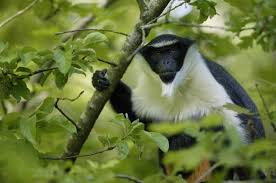
The Roloway Monkey
The Roloway monkey, or Cercopithecus roloway, is an endangered species found in the jungles of West Africa. This guenon (Old World monkey) is distinguishable by its long beard. Roloway monkeys live in the canopies of jungles and rainforests in Ghana, Sierra Leone, Guinea, and Liberia among other West African areas. The Roloway monkey is an omnivore, and eats a diverse selection of insects, fruits, seeds, and flowers. This monkey is endangered because of hawk-eagles, chimpanzees, leopards, and, most of all, humans. Africans kill the Roloway monkey for their bushmeat, a delicacy in West African cultures. The monkeys also breed less often because groups of males will stray off from their group, and the females will stay behind. The Roloway monkey is diurnal, and will spend its days hunting and sometimes playing in the lush African rainforests and jungles.

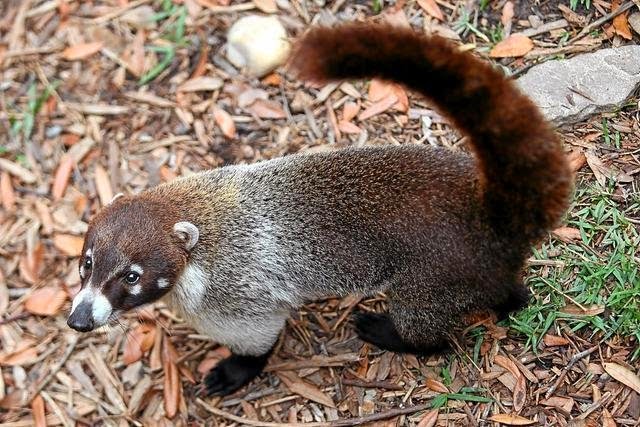
White-Nosed Coatimundi
The white-nosed coatimundi, or Nasua narica, is a raccoon-like mammal. The coatimundi, more commonly called the coati, lives in central America and the deserts of the southwestern states of America. It is a social animal and travels in groups of up to 24. The Coati can grow up to five feet long and can weigh up to 25 pounds. Coatis are diurnal and spend their days searching for insects, lizards, roots, fruits, and nuts to eat.

Subscribe to:
Posts (Atom)